Article · 6 min read
Do Word and Number Puzzles Train Your Brain? An Honest Look
Word and number puzzles build real skills, but evidence for wider brain benefits is limited. What they do well, what they don't, and how to enjoy them.

Published 29 September 2026 · How we write guides
Word and number puzzles are often sold as brain training. The pitch is that a few minutes a day will sharpen your memory, speed up your thinking or keep your mind young. It is an appealing idea, and puzzles are genuinely good for some things. But the stronger claims go further than the evidence supports. This guide takes an honest look at what puzzles like Wordfall and Sumspill on this site actually exercise, what you can reasonably expect to get from them, and why "it's fun" is a perfectly good reason on its own.
What these puzzles ask you to do
Before talking about benefits, it helps to be precise about the task.
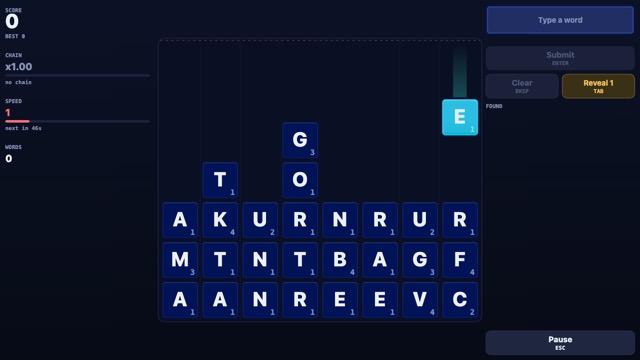
Wordfall drops letters into a well eight columns wide and seven tall. You spell words of three to ten letters from any letters in the well; they do not have to touch. Letters in the word leave, the letters above them drop, and every 55 seconds letters arrive faster. When a letter lands on a full column, the run is over. Longer words score much more: a three-letter word is multiplied by 1, a seven-letter word by 3.8 and a ten-letter word by 8.
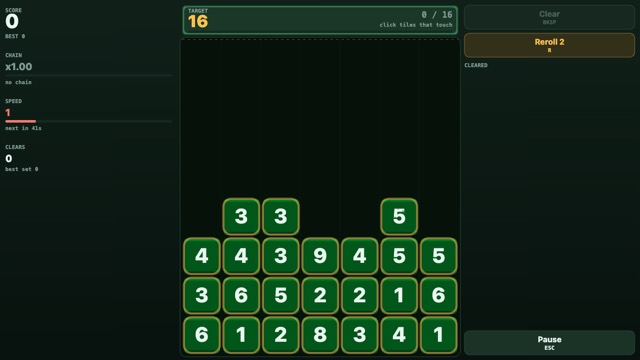
Sumspill drops digit tiles from 1 to 9 into a well seven columns wide and eight tall, with a target number above it. You pick tiles that touch side by side or above and below, so their sum hits the target exactly. Bigger groups pay more: three tiles multiply the target by 1, six by 3.4 and ten or more by 9.4. Every 50 seconds tiles fall faster and targets grow.
Both games combine a thinking task, finding words or sums, with time pressure and a bit of planning about which tiles to use.
What they genuinely exercise
Doing these puzzles does practise specific skills. That part is not in doubt: you get better at what you practise.
In word games
- Vocabulary recall. Finding words from a jumble means pulling words out of memory on demand. Over time you notice common letter patterns and endings more quickly.
- Spotting patterns in letters. You start to see useful clusters like "-ING", "-ER" or "RE-" in a mess of tiles.
- Choosing between options. Wordfall pays far more for long words, but the well keeps filling. Deciding whether to hunt for a seven-letter word or grab a quick three to relieve a column is a real trade-off.
In number games
- Mental addition. Sumspill is constant small sums. Your speed at adding single digits will improve with play.
- Spatial search. Because tiles must touch, you are searching for connected shapes as well as totals.
- Planning under pressure. Bigger groups pay more but take longer to find, while the well keeps filling.
Things both share
- Focus. A run needs steady attention for a few minutes. That is a pleasant kind of concentration, the kind where time passes quickly.
- Handling time pressure. Both games speed up. Staying calm as the well fills is a skill in itself.
What the evidence does not support
The harder question is whether getting better at these puzzles makes you better at other things: remembering names, managing money, avoiding memory decline as you age.
Research on "brain training" has looked at this for years. The broad picture, as it is widely understood, is:
- People improve at the task they practise. This is consistent and unsurprising.
- Improvement sometimes carries over to very similar tasks. Getting faster at one kind of word search may help with a closely related one.
- Evidence for broad transfer is weak and contested. Improvements on puzzle games have generally not been shown to reliably carry over into general memory, intelligence or everyday thinking.
In practical terms: playing Wordfall will make you better at Wordfall and probably at similar word games. It will not reliably improve your memory for where you left your keys. Playing Sumspill will speed up your single-digit addition. It will not make you better at maths in general, and it will not protect you from any illness.
It is also worth being wary of any product that promises specific results, such as a percentage improvement in memory, from playing puzzles. Claims like that should come with strong evidence, and often do not.
What puzzles can honestly offer
None of this makes puzzles pointless. There are good, modest reasons to enjoy them.
- Enjoyment. Finding a long word or a big group is satisfying. That is reason enough.
- A break with structure. A short run gives your attention one clear job for a few minutes, which many people find relaxing.
- Skill you can see. Both games keep records in your browser. Wordfall tracks your best score, best single word and longest word; Sumspill tracks your best score, best single clear and biggest group. Watching those grow is a real, if small, sense of progress.
- A daily habit. Both games track a daily streak. Returning to something you enjoy is a nice routine, even without any bigger promise attached.
- Language and number practice. For someone learning English, hunting for words in Wordfall is honest vocabulary practice. For a child building number fluency, Sumspill is honest addition practice. These are narrow benefits, but real ones.
Getting more out of word puzzles
If you want to improve at word games, these habits help:
- Look for endings first. Plurals and forms ending in -ED and -ING are accepted in Wordfall, and those endings can turn a short word into a long one.
- Use rare letters. In Wordfall, common letters like E, A and S score 1, while X, Z, J and Q score 8. A word that uses a Q clears a stubborn tile and scores well.
- Keep a chain going. Each word within nine seconds of the last adds 0.2 to the next word's multiplier, up to 3. A quick short word can be worth it to keep the chain alive.
- Trust the tile picker. When you type a letter, Wordfall takes it from the tallest column it appears in, which relieves the column closest to overflowing.
- Use your reveals. You start each run with one Reveal, which stages a common word at half points. Any word of seven or more letters earns one back, up to five.
Getting more out of number puzzles
- Build big, not fast. In Sumspill a target of 21 made from six tiles pays 71 instead of 21. One big group beats several small ones.
- Use the dimmed tiles. Tiles that would overshoot the target, or that do not touch your group, are dimmed. They tell you which paths are dead ends.
- Do not empty the well. Targets come from the groups on the board, so a nearly empty well only offers small targets that pay less.
- Keep a Reroll for bad targets. You start with two Rerolls, each swapping the target for another that exists on the board, and any clear of six or more tiles gives one back.
It is reassuring that every Sumspill target is possible: the game only picks sums with at least three different answers on the board. If you cannot see one, it is there.
A balanced view
Puzzles are a good hobby. They are absorbing, they reward practice, and they build specific skills you can measure. What they are not is a proven way to improve your mind in general. Treat them as you would a crossword or a game of cards: something enjoyable that keeps you engaged, not a treatment.
If you want to support your thinking more broadly, the usual advice is familiar and unexciting: sleep, physical activity, social contact and learning genuinely new things. A puzzle game can sit happily alongside those. It just should not be asked to replace them.