Article · 7 min read
How to Think About Sort Puzzles: Spares, Planning Backwards and Undo
Sort puzzles reward planning over speed. Learn how spare containers work, why you should plan backwards from the finish, and how to use undo to solve cleanly.

Published 29 September 2026 · How we write guides
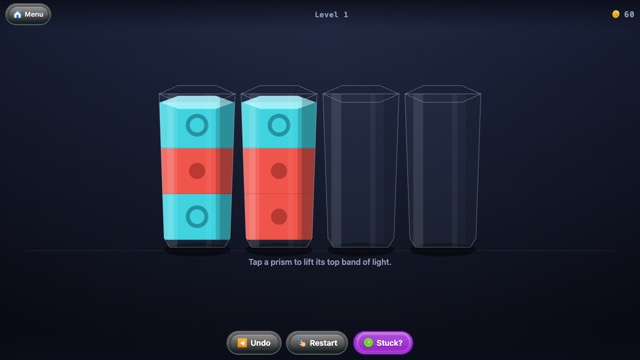
Sort puzzles give you a set of containers holding mixed-up colours and ask you to move them until each container holds only one colour. Some versions use balls in tubes, some use liquid in bottles, and Prism Sort on this site uses bands of coloured light in glass prisms. The rules are always small: you can only move the top of a container, and only onto a matching colour or into empty space. The difficulty comes from space. With too few empty spots, a careless move can lock the board. This guide explains how to think about these puzzles so you spend less time stuck and more time solving.
The rules, in general and in Prism Sort
Most sort puzzles share these rules:
- You move the top item, or the top run of one colour, from one container to another.
- It can only land on top of the same colour, or in an empty container.
- Containers have a fixed capacity.
- The puzzle is solved when every container holds a single colour or nothing.
Prism Sort follows this pattern. You tap a prism to lift the run of one colour sitting on top, every prism that can take it lights up, and tapping a lit prism pours it. Only as much as fits goes across. There is no timer and no way to lose, which makes it a good place to practise the thinking below.
One detail matters a lot: whether a move takes the whole run of a colour or just one piece. In Prism Sort, you lift the whole run, but only as much as fits pours across, so a partial pour can leave some of the run behind. Knowing exactly how your game handles runs changes which moves are safe.
Spare containers are your working space
The most important idea in sort puzzles is the spare: a container that starts empty. Spares are not just extra room. They are the only place you can put a colour that has no matching top anywhere else. Without a spare, you can only move a colour onto the same colour, which often means no progress is possible.
Think of spares as your working memory. Every time you put something in a spare, you use some of that memory. When all spares are full of unsorted colours, you are close to a dead end.
Prism Sort makes this explicit. Levels 1 to 11 give you two spare prisms throughout. From level 12, some boards drop to a single spare, so even a board with fewer colours needs planning several pours ahead. The game's own advice for one-spare boards is to fill the last empty prism only when you can already see how to empty it again.
The two kinds of good use for a spare
- Parking. You move a colour into a spare to uncover what is underneath, knowing that colour will soon have a home.
- Collecting. You pick one colour to build in the spare, adding to it as tops become available, until it is complete.
A bad use is putting something in a spare just because it is the only legal move. That is usually the start of a stuck board.
Plan backwards from the finished board
When a board looks tangled, it helps to stop asking "what can I move?" and ask "what does the end look like, and what has to happen just before it?"
A few questions help:
- Which colour is closest to done? A container that already holds mostly one colour, with one or two other pieces on top, is a good early target. Clearing those few pieces off finishes it.
- Which colour is buried deepest? A colour sitting at the bottom of several containers will be the last to finish. You do not need to worry about it early.
- Where will each colour end up? Often a container that has one colour at the bottom will naturally become that colour's home. Plan to keep the bottom intact and clear what is above it.
Working backwards turns one big problem into a few small ones: "empty the top of this container", then "find a home for what I removed".
Look before you pour
Before each move, ask three quick questions:
- Does this move uncover something useful? Moving a run to reveal a colour that has a home elsewhere is progress. Moving a run to reveal something with no home is not.
- Does this move fill my last empty space? If yes, do you know how to empty it again?
- Can I undo the effect later? Some moves are easily reversed; others bury a colour under something that will be hard to shift.
Most stuck boards come from a move that failed the second question.
Count moves ahead, not just one
A useful habit is to trace a short sequence before starting it. For example: "Pour red into the spare. That uncovers blue, which goes onto the blue prism. That uncovers green, which goes on top of the green in the third prism. Now the first prism is empty again." If the sequence ends with a spare freed up, it is almost always good. If it ends with every spare full, look for something else.
This is also where par comes in. Prism Sort pays a bonus for finishing at or under par, which is the fewest pours the board could possibly need, plus two. Planning a sequence in your head before pouring is what keeps you near par.
Use undo as a thinking tool
In puzzles where undo is free, it is not a crutch; it is a way to test ideas. Prism Sort's undo and restart are free and unlimited, and undoing a pour also takes it off your move count, so trying an idea and backing out never costs you par.
Use undo deliberately:
- Explore a line. Try a sequence that might work. If it leads nowhere, undo back to where it started.
- Mark your branching point. Remember the position where you had a real choice. That is where to return to.
- Do not undo randomly. Undoing one move at a time and trying the next legal move is slow. Undo back to the last real decision instead.
Restart is useful when you realise your early moves were aimless. A fresh start with a plan is often faster than repairing a messy board.
When you are stuck
Even with good habits, some boards will stop you. Prism Sort offers help for coins: a hint for 25, a rewind for 30 and an extra prism for 40, once per level. The rewind is useful because it steps back to a position that can still be solved, which saves you from guessing how far to undo. The extra prism is simply more working space.
Every Prism Sort board is checked as solvable before you see it, so being stuck always means an earlier move closed a door, never that the board is impossible. That is worth remembering: if you are stuck, the answer is behind you.
Colours that are hard to tell apart
Sort puzzles depend on telling colours apart quickly. If two colours look similar to you, whether because of lighting, screen settings or colour vision, the puzzle becomes much harder than intended. Prism Sort gives each of its twelve colours its own symbol, such as a dot, ring or star, which can be switched on from the menu. If your game offers something like this, use it.
The same thinking in related puzzles
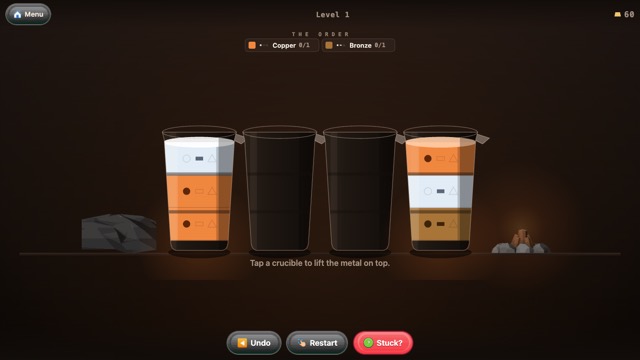
The habits here carry over to other puzzles built on moving items between containers. Meltpour on this site is one, with a twist: pouring one metal onto a different alloy fuses them into a new alloy permanently, and the goal is to fill an order of specific alloys rather than just separate colours. The spare still matters in the same way, since an empty crucible is the only place metal can wait without meeting another alloy, and from level 9 some benches have only one. Planning backwards from the order, and keeping enough of each raw metal apart until its mould is filled, is the same thinking applied to a harder rule.
Summary
- Spares are working space; protect the last one.
- Start with the container closest to finished.
- Plan a short sequence before each pour, and prefer ones that free a spare.
- Use undo to test ideas, and undo to the last real decision.
- If stuck on a solvable board, the mistake is behind you.
Sort puzzles are calm, untimed and forgiving. They reward the same careful thinking you would use to tidy a crowded shelf: know where things belong, keep a clear space, and move with a plan.