Article · 7 min read
Card Battlers for Beginners: Mana Curves, Tempo and Trading
A beginner's guide to card battlers: how mana curves work, tempo versus value, when to trade units, and how fixed decks differ from deckbuilding.

Published 29 September 2026 · How we write guides
Card battlers are strategy games played with a deck. Each turn you draw cards, spend a limited resource to play them, and try to bring your opponent's health to zero before they do the same to you. The rules of any single game are usually short, but the decisions stack up quickly: which card to play now, which to save, what to attack and what to leave alone. This guide covers the ideas that most card battlers share, and shows how they apply in Emberdeck, the card game on this site.
How a typical turn works
Most card battlers follow a pattern like this:
- At the start of your turn you gain resources and draw a card.
- You spend resources to play cards from your hand. Units stay on the board; spells have an effect and are gone.
- Units already on the board can attack enemy units or the enemy hero.
- You end your turn, and your opponent does the same.
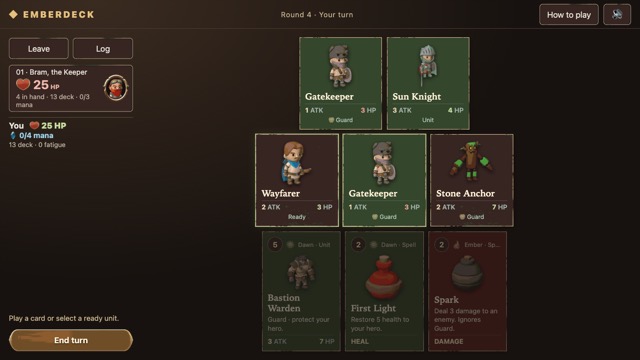
Emberdeck follows this closely. Both heroes start on 25 health. Each turn your maximum mana rises by one, up to 8, and you draw a card. Units wait a turn before they can attack. You win by bringing the enemy hero to zero.
The resource is usually called mana, and the rising cap is the key to everything that follows. On turn one you can only afford cheap cards; by turn eight you can afford your most powerful ones.
The mana curve
A mana curve is the spread of costs across your deck. If you counted how many cards cost 1, 2, 3 and so on and drew a bar chart, it would usually look like a hill: many cheap and mid-priced cards, fewer expensive ones.
Why does the shape matter? Because unused mana is wasted. If your hand on turn two holds only cards that cost five, you do nothing that turn while your opponent develops their board. If your hand on turn seven holds only one-cost cards, you spend your turn on small effects while your opponent plays something big.
A good curve means you usually have something sensible to do with your mana every turn. As a rough guide for a deck in a game where mana grows by one per turn:
| Cost | Role | Share of the deck |
|---|---|---|
| 1–2 | Early plays, cheap answers | A good chunk |
| 3–4 | The backbone of the middle turns | The largest group |
| 5–6 | Strong plays once the game settles | Fewer |
| 7+ | Finishers and big swings | Only a few |
This is a guideline, not a law. Aggressive decks lean cheaper and slower decks carry more expensive cards, but too many will leave you idle early.
In Emberdeck, decks are exactly 20 cards with at most two copies of each. With only 20 cards you see a large share of your deck in every match, so the curve shows up quickly: a deck heavy at the top will feel it by the second or third turn.
Tempo and value
Two words come up constantly in card game strategy.
Tempo is about using your mana efficiently turn by turn, so you are the one setting the pace. A player with good tempo has more on the board than their opponent and forces the opponent to react.
Value is about getting more out of your cards than your opponent gets out of theirs. A card that removes two enemy cards, or draws you extra cards, gives value. Over a long game, the player with more resources left usually wins.
The two often pull against each other. Spending a card to kill a small enemy unit right away is good for tempo, but might waste a strong removal spell on a weak target, which is poor value. Holding that spell for a bigger threat is good value, but you might take extra damage in the meantime.
A simple way to decide: ahead on board, play for value; behind, play for tempo and regain control, even if it costs a good card.
Card draw and the hand limit
Drawing extra cards is value. But most games limit how many cards you can hold. In Emberdeck, cards drawn into a full hand of eight are discarded. Deep Insight draws two cards, so it is best played with room in your hand, not as your last card when your hand is nearly full.
Decks also run out. In Emberdeck, each draw from an empty deck deals fatigue damage to that hero: 1, then 2, then 3 and so on. In a long game, drawing too many cards can end up hurting you.
Trading units
When your unit attacks an enemy unit, the two usually damage each other. This exchange is called a trade.
The basic question in any trade is: who comes out ahead? A good trade is when a cheap unit of yours destroys a more expensive unit of theirs, or when your unit survives and theirs does not. A bad trade is the reverse.
In Emberdeck, a unit that attacks another unit also takes that unit's attack as damage. Attacking the hero costs nothing in return. So the game's own advice is to trade only when the exchange favours you.
When to go face
Attacking the enemy hero directly is called "going face". It is right when:
- You are the more aggressive deck and can win before your opponent's stronger cards arrive.
- Your opponent cannot punish you for ignoring their units.
- You can see lethal: enough damage to win this turn or next.
Trading is the right choice when enemy units threaten to deal more damage than you can, or when a unit enables something dangerous.
Guard and similar rules
Many card battlers have a keyword that forces attacks onto certain units. In Emberdeck it is Guard: Guard units must be attacked first. Spells ignore Guard, though. Spark deals 3 damage to any enemy, hero included, so it can clear a Guard unit holding back your attackers, or finish the last 3 health of the enemy hero.
Freeze effects are another common tool. In Emberdeck, Winter Seal costs 1 and makes a unit miss its owner's next turn. Casting it on the biggest enemy attacker just before you end your turn means that attack never happens.
Reading your opponent
Against a computer opponent, it helps to know how it thinks. Emberdeck's opponent goes for your hero when that is lethal. Otherwise it kills any unit it can finish in one hit, preferring Guards and high attack. Tough units draw its attacks less.
The three opponents also play different styles:
- Bram, the Keeper plays a wall of Guard units and healing. Save your damage for the key defenders.
- Vexa, Ash Captain attacks early with fragile units. Trade units and protect your health.
- Orin, Winter Oracle freezes threats and draws cards before stronger late units arrive. Pressure him early.
Against an aggressive opponent, play for tempo and trade; against a slow one, press early.
Fixed decks versus deckbuilding
Card battlers come in two broad shapes.
Fixed-deck games give every player the same deck, or a small choice of prebuilt decks. The challenge is all in how you play.
Deckbuilding games let you choose which cards go in your deck, so you must build a deck with a good curve and a plan, then play it well. Some have you collect cards over time, sometimes by buying packs; others give you every card from the start.
Emberdeck sits in between in a beginner-friendly way. All 18 cards are available from the first match, and there are no packs to unlock or buy. You can load a Dawn, Ember or Tide starter deck, or open Forge deck and build your own 20 cards, mixing factions freely.
For a beginner, a good path is:
- Play a few matches with each starter to learn the cards.
- Notice which cards you were always happy to draw, and which ones sat in your hand.
- Build a deck that keeps the cards you liked, with a sensible spread of costs.
- Test it against each opponent and adjust.
One thing to know: Emberdeck keeps your deck and the opponents you have beaten only while the page is open. Reloading returns you to the Dawn starter deck.
The core ideas in one list
- Spend your mana every turn if you can.
- Build a deck shaped like a hill, not a cliff.
- Play for tempo when behind, for value when ahead.
- Trade when it favours you; go face when you can outrace them.
- Learn how your opponent decides, and plan around it.
Card battlers reward thinking a turn or two ahead, and these ideas carry over to almost every game in the genre.