Article · 7 min read
What Is a Survivors-Like? How Bullet Heaven Games Work
Survivors-likes hand you one job, moving, while your weapons fire themselves. Here is how the genre works, why runs ramp up, and how to build a run that lasts.

Published 29 September 2026 · How we write guides
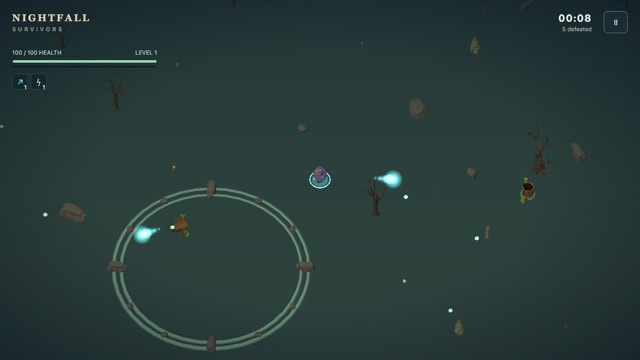
A survivors-like is an action game where you steer a character through an ever-growing crowd of enemies while your attacks fire on their own. You never press an attack button. Your decisions come in two places: where you move from moment to moment, and which upgrade you pick each time you level up. The genre took its name from Vampire Survivors, the game that made the format popular, and it is also called "bullet heaven", a reversal of "bullet hell": instead of weaving through the enemy's projectiles, you are the one filling the screen with them. This guide explains the parts that make these games tick and how to get better at them, using examples from Survivors Arena, Nightfall: Survivors and Swarm Dodge.
The core loop
Almost every survivors-like runs on the same loop:
- Enemies walk toward you from all sides.
- Your weapons attack automatically, usually aiming at the nearest target or firing in a fixed pattern.
- Defeated enemies drop experience, which you collect by walking over it.
- A full experience bar pauses the action and offers you a choice of upgrades.
- The enemies grow in number and toughness, and the loop repeats until you win or fall.
Survivors Arena follows this closely. You steer a knight with the keyboard or a drag of the thumb, monsters drop experience, and every level-up offers cards: a new weapon, a higher rank for a weapon you already carry, or a passive such as more speed or health. Nightfall: Survivors works the same way, with souls instead of gems and a choice of three skill upgrades per level.
Because you only move, the genre is easy to start. The difficulty lives in the decisions, and those decisions stack up over a run.
Why runs ramp up
The defining feeling of a survivors-like is the ramp. The first minute is quiet: a handful of slow enemies and one weak weapon. Ten minutes later the screen is full. The game is built so that the enemy count and the power of your build grow together, and the question is which grows faster.
In Survivors Arena the horde grows from about forty monsters to several hundred over a twenty-minute run, with a boss at 5, 10, 15 and 19 minutes. Nightfall: Survivors is shorter and tighter: three bosses arrive at 1:00, 2:20 and 3:40, and beating all three wins the run.
This ramp is why early choices matter so much. An upgrade picked at minute two has eighteen minutes to pay off. A poor pick early does not kill you straight away; it shows up later, when the crowd arrives and your build cannot clear it fast enough.
Build choices: coverage before power
The most common beginner mistake is stacking everything into one weapon. A single strong weapon that fires forward leaves your back and sides open, and in a game where enemies come from every direction, gaps kill you.
A better first goal is coverage. Think about how each weapon aims:
- Orbiting weapons circle close to you and protect against anything that reaches you.
- Targeted weapons pick off enemies at range, often the nearest one.
- Area weapons damage everything in a ring around you.
- Directional weapons spray in the way you are facing or moving.
Survivors Arena spells this out in its weapon list: Orbit Shards circle you, Auto Bolt picks targets, Frost Halo surrounds you and Scorch Fan sprays ahead. Taking one of each kind early means there is no side the crowd can approach from without being hit. Once you are covered, pour upgrades into whichever weapon is doing the most work.
Slot limits force these trade-offs. Survivors Arena lets you carry six weapons and six passives, each with five ranks. Once the slots are full, every new card is a rank-up, so the weapons you took early define the rest of the run.
Passives are not filler
It is tempting to skip passive upgrades in favour of more damage. Some passives change how the whole run plays, though. A pickup-range passive, like Lodestone in Survivors Arena, pulls experience toward you from further away. That means you level faster without walking into the crowd to collect gems, which is safer and speeds up every other upgrade. Movement speed and maximum health do similar quiet work: they widen your margin for error.
Starting kits shape your plan
Some survivors-likes let you choose a character with a starting weapon. In Nightfall: Survivors, the Arcanist starts with Storm link, lightning that jumps between enemies and is strong against tight groups. The Warden starts with 125 health, the most of the three, and a stone guardian that slams and slows nearby enemies. The Pyrewalker starts with flames circling close to the hero. Each start pushes you toward a different early plan: the Arcanist wants enemies bunched up, the Warden can afford to stand closer, and the Pyrewalker wants enemies near the hero.
Movement is the real skill
Since your attacks aim themselves, your movement decides everything. A few habits carry across the whole genre.
Keep moving. Standing still lets enemies close the circle around you. Once you are surrounded, even a strong build can be overwhelmed because enemies reach you faster than you can clear them.
Circle the crowd. Rather than running away in a straight line, move around the edge of the horde. Your weapons then hit the outer layer of enemies continuously, and you are never cornered.
Leave through the widest gap. When enemies close in from several sides, pick your exit early. Waiting to see where they settle usually means the gap closes.
Watch the edges of the screen. New enemies arrive from off screen. The danger you have not seen yet is often the one that ends a run.
Swarm Dodge is a useful training ground for this because it strips out everything except movement. You have no weapon at all. Monsters walk in from the edge of the screen furthest from you, one more every five seconds, and all of them speed up over time. You score by collecting motes and by grazing past monsters without touching them. The monster types also teach specific dodging lessons: wizards aim at where you are heading rather than where you are, so running straight away leads you into their path, and mages come in packs of three that spread out to close off a direction. Every run ends when something catches you, so the goal is a better score than last time.
Active abilities and timing
Some survivors-likes add a few buttons on top of movement. Nightfall: Survivors gives you a dash and a nova. The dash makes you untouchable for under half a second, so the best use is to go through a gap or a boss's telegraphed attack, not away from it. The nova has a 14-second cooldown and freezes and knocks back everything close to you, which is often enough to walk out of a surround.
The general rule for cooldown abilities: save them for the moment that would otherwise end your run.
Bosses and priority targets
Bosses are the checkpoints of a run. In Survivors Arena each boss drops a chest with an upgrade, so having your strongest weapon ranked up before each boss time pays twice: you survive the fight and you get the reward sooner.
Ordinary enemies are not all equal either. In Nightfall: Survivors, rot menders heal nearby allies and blight bloaters swell for under a second before bursting. Killing those first is worth more than clearing the nearest weak enemy. Shielded brutes soak shots from the front, so freezing them, flanking them or using area damage gets through. Learning which enemy types to deal with first is how experienced players survive crowds that beginners cannot.
Short runs and permanent progress
Survivors-likes are roguelites: each run starts mostly fresh, and a lost run is expected. Some games add a thin layer of permanent progress. Survivors Arena lets you spend gold from each run on six kinds of permanent upgrade, kept in your browser. Nightfall: Survivors carries nothing over; every run starts with your chosen hero at rank one.
Both designs have their appeal. Permanent upgrades mean a bad run still moves you forward. A clean start every time means your improvement is all your own, and runs of one to six minutes make a quick retry easy.
A simple plan for your next run
- Pick weapons that aim in different ways before stacking one.
- Take a pickup-range or speed passive early if one is offered.
- Keep moving around the edge of the crowd, never into a corner.
- Hold escape abilities for real emergencies.
- Know when the bosses arrive and be strong before then.
- Kill healers and exploders before the rest.
None of this needs quick reflexes. The genre rewards planning and calm movement.