Article · 7 min read
Racing Lines for Time Trials: Braking, Apexes and Exit Speed
The basics of a racing line for time trials: outside-inside-outside, where the apex goes, why you brake before the turn, and why exit speed decides your lap time.

Published 29 September 2026 · How we write guides
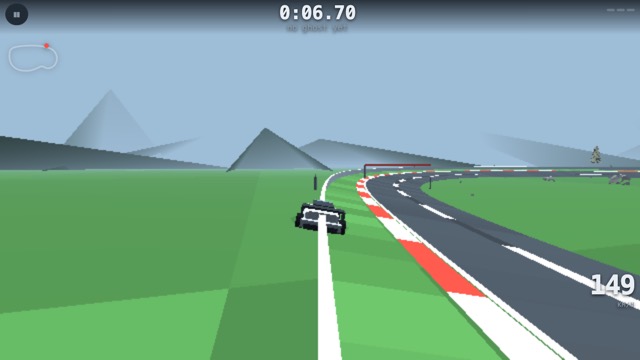
In a time trial there is no one to overtake and no one to block you. It is just you, the track and the clock. That makes it the purest way to learn how to drive a lap well, and the single biggest idea to learn is the racing line: the path through a corner that lets you carry the most speed. This guide explains the basics in plain terms and shows how they apply in Facet Circuit, the time trial game on this site.
Why the line matters
A car can only turn so sharply at a given speed before its tyres lose grip. The tighter the curve you drive, the slower you must go to stay on the road. So the goal through any corner is to make the curve you actually drive as wide and gentle as possible, using all the track available.
Facet Circuit models this directly. Speed through a corner is capped by grip, so steering harder past that limit does nothing. The only way to go faster through a bend is to make the bend you drive gentler, which is exactly what a good line does.
Outside, inside, outside
The classic racing line through a single corner follows three points:
- Turn-in on the outside edge of the track, before the corner.
- The apex on the inside edge, where you get closest to the inside of the bend.
- Track-out back on the outside edge as you leave the corner.
Imagine a right-hand bend. You approach on the left side of the road, sweep across to touch the right-hand edge in the middle of the bend, then let the car drift back out to the left edge on the exit. This path is a much wider arc than simply following the middle of the road, so you can carry more speed.
Where to put the apex
The apex is not always the geometric middle of the corner. Where you put it changes how the corner feels.
- Early apex: you touch the inside edge before the middle. You turn in early and fast, but the second half of the corner becomes tighter, and you often have to slow down or run wide on the exit.
- Late apex: you touch the inside edge after the middle. You turn in later and a little slower, but the exit is straighter, so you can get back on full speed sooner.
For most corners, especially those leading onto a straight, a slightly late apex is faster overall. Beginners tend to turn in too early, which is the most common cause of running wide on the exit. Facet Circuit's first track, Sable Ring, is described as having a late apex, so it is a good place to practise this.
Brake before the turn, not during it
Tyres have a limited amount of grip, and it is shared between slowing down and turning. If you brake hard while also turning hard, you ask the tyres to do two things at once and they may not manage both.
The simple rule for beginners:
- Brake in a straight line before the corner.
- Release the brake as you turn in.
- Steer through the corner at a steady speed.
- Straighten up and accelerate out.
Facet Circuit's advice puts it simply: brake once, early. One firm brake before turn-in beats steering out of a late entry. Because the car accelerates by itself and you only steer and brake, it is easy to focus on this one skill.
Finding your braking point
A braking point is a fixed spot, such as a kerb, a sign or a change in the track surface, where you start braking. Use the same spot each lap. If you arrive at the corner too slow, move the braking point a little later next time. If you run wide, move it earlier. Changing one braking point at a time makes it clear what helped.
Why exit speed matters most
Here is the idea that separates quick laps from slow ones: the speed you have leaving a corner matters more than the speed you have entering it.
The reason is simple. Whatever speed you carry out of a corner, you keep for the whole of the straight that follows. A small gain on the exit is multiplied by the length of the straight. A small gain on the entry only lasts for the few metres before you have to slow down anyway.
This is why the late apex usually wins. You give up a little speed on the way in, but you straighten the car earlier and start accelerating sooner, which pays off all the way down the next straight.
The corners that matter most are the ones before the longest straights. In Facet Circuit, Cinder Loop has a hairpin waiting at the end of its fastest straight. The hairpin itself is slow no matter what; the exit onto the next stretch is where the time is.
Staying on the track
Running wide off the track surface is usually much slower than a slightly cautious line. In Facet Circuit, grass has about a third of the tarmac's grip and far more drag, and the kerbs are slower too. Hitting a barrier cuts your speed roughly in half. The game's advice is that running wide on an exit usually costs more than a slightly slower entry.
There is a practical lesson here: a lap that is ninety per cent committed and clean is almost always faster than one that pushes too hard and runs off once. Facet Circuit rewards this with coins as well: a lap with no barrier contact pays 15 extra.
Corner combinations
Real tracks rarely have isolated corners. Two or more bends close together need a different approach.
- Chicanes are quick left-right or right-left sequences. The line through the first bend has to set up the second. Often you sacrifice the first corner slightly to get a straight, fast exit from the last one. Sable Ring has a chicane.
- Double corners in the same direction can sometimes be taken as one long, smooth curve. Wick Ridge climbs to a blind crest before a double left.
- Hairpins are very tight turns of about 180 degrees. Brake hard and early, take a late apex, and focus on the exit.
The general rule: in a sequence of corners, prioritise the exit of the last corner before a straight.
Narrow tracks
On a wide track you have room to use the full outside-inside-outside line. On a narrow one, barriers limit how wide you can go, so every corner is tighter and mistakes cost more. Glass Spine is Facet Circuit's narrowest circuit, with the tightest corners and barriers close on both sides. There, smoothness matters more than aggression.
Learning a track systematically
Time trials give you useful tools for improving.
Sectors. Facet Circuit splits each lap into three sectors and shows whether you gained or lost time in each. When a sector shows a loss, that third of the lap is where to change a braking point next time.
Ghost laps. The game shows a ghost of your best lap. Watching where the ghost pulls away from you shows exactly which corner you took worse.
Medal targets. Each circuit has bronze, silver and gold times. Sable Ring's gold is 0:19.36 and bronze 0:24.01; Glass Spine's gold is 0:30.05 and bronze 0:37.27. A bronze unlocks the next circuit, so you can move on and come back for better medals later.
A good practice routine:
- Drive a few calm laps to learn where each corner goes.
- Pick the corner before the longest straight and work on its exit.
- Set a braking point for each corner and adjust one at a time.
- Use the sector times to find the next weakest part of the lap.
- Only chase the gold once the lap is consistently clean.
Letting the car help you
Small details of how a car handles can help you drive smoothly. In Facet Circuit, with no steering input, the car gently straightens toward the direction of the track. The game suggests lifting your thumb on the exit of a corner rather than holding a correction too long. Over-correcting is a common beginner habit, and letting go is often the smoother choice.
Summary
- Use the whole width of the track: outside, inside, outside.
- Prefer a slightly late apex, especially before a straight.
- Brake in a straight line before turning in.
- Exit speed matters more than entry speed.
- A clean lap beats a fast lap with one mistake.
- Change one braking point at a time and use sector times to find your losses.
These basics apply to any racing game and to real driving on a track. The clock in a time trial will tell you honestly whether each change helped.