Article · 6 min read
Match-Three Special Pieces Explained, and How to Read the Board
How match-three special pieces are made and combined, which shapes create which specials, and the board-reading habits that turn a few moves into big clears.

Published 29 September 2026 · How we write guides
Match-three puzzles look simple: swap two neighbouring pieces to make a line of three of the same kind. The depth comes from what happens when you do better than three. Longer lines and certain shapes leave behind special pieces, and specials swapped together set off effects much bigger than either alone. Once you understand how specials form, you stop hunting for any match and start looking for the right one. This guide covers how specials generally work in the genre, the exact rules used by Gem Cascade on this site, and the habits that help you read a board.
The basics every match-three shares
Nearly all match-three games share a few rules:
- You swap two pieces that sit next to each other, horizontally or vertically.
- The swap must create a line of three or more of the same kind. In many games, including Gem Cascade, a swap that makes no match is undone.
- Matched pieces disappear, the pieces above fall into the gap, and new pieces fill from the top.
- If the falling pieces happen to form new lines, those clear too. This chain reaction is called a cascade.
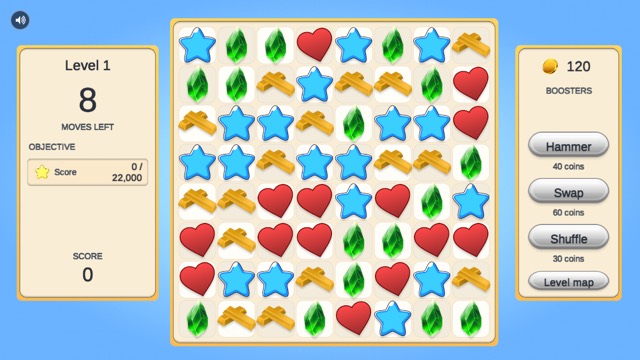
Most modern match-three games also give each level a goal and a limit. In Gem Cascade, each of the forty levels shows its goal at the top, such as a score or a number of one piece to collect, and gives you a limited number of moves to finish it.
How special pieces form
Across the genre, the general pattern is that bigger or more complex matches earn stronger specials. The exact rules differ from game to game, so it is worth learning them for the game you are playing. In Gem Cascade they are:
| Match you make | Special piece left behind | What it does |
|---|---|---|
| Four in a row | Row clearer | Clears a whole row |
| Four in a column | Column clearer | Clears a whole column |
| L or T shape | Bomb | Clears a 3×3 block around it |
| Five in a line | Colour bomb | Clears every piece of one kind |
Two details are worth knowing. First, shape outranks length: if a match forms both an L or T shape and a line of four, you get the bomb. Second, five in a line always makes a colour bomb, whatever else the match does.
L and T shapes happen when two lines of three share a corner or a middle piece. They are easy to miss because you are usually scanning for straight lines, but they appear often once the board has a few cascades going.
Combining specials
Specials are strong alone. They are far stronger when swapped with each other. In Gem Cascade, the combinations are:
- Line + line: clears a full row and a full column.
- Line + bomb: clears three rows and three columns.
- Bomb + bomb: clears a 5×5 area.
- Colour bomb + line or bomb: turns every piece of that colour into that special, then fires them all.
- Colour bomb + colour bomb: clears the whole board.
The rule of thumb that holds in this game and most others: a combination always does more than either piece on its own. That is why the tip in Gem Cascade's guide is to save specials. A special stays on the board until you use it, so there is rarely a reason to fire a single special the moment it appears if a second one might form nearby.
When to fire a special straight away
Saving is not always right. Fire a special immediately when:
- It will finish your goal this move.
- You are nearly out of moves and a combination is not in sight.
- It sits next to an obstacle you need to break.
- Leaving it risks it drifting somewhere unhelpful as pieces fall around it.
Reading the board
Good match-three play is less about spotting any match and more about spotting the match that sets up the next one. A few habits help.
Work from the bottom
A swap near the bottom of the board moves every piece above it when the matched pieces clear. That reshuffles a large part of the board and gives cascades a chance to start. A swap near the top only affects the pieces above it, which is very few. When two matches seem equal, the lower one usually has more upside.
The trade-off is that bottom swaps are less predictable. If you are setting up a specific special higher up, a lower match might knock your setup apart. Use the bottom when you want luck to work for you; use the top when you want the board to stay still.
Look for "almost" shapes
Before taking an obvious three, scan for places where one more piece would make a four, an L or a five. Often a single move elsewhere drops the missing piece into place. This takes practice but is the biggest step from beginner to confident player.
Count colours near each other
If three or four pieces of the same kind are clustered in a small area, there is often a special hiding in them. Isolated pieces rarely lead anywhere.
Read the goal before the board
In Gem Cascade, a score goal and a collect-this-piece goal want different moves. If the level asks for a number of one kind of piece, a match of another kind only helps if it causes a useful cascade. Chasing matches you do not need spends moves you cannot get back.
Obstacles and how specials help
Many match-three games add obstacles that make boards harder. Gem Cascade's include:
- Ice, which sits under a piece in layers; the piece above it is still playable.
- Crates, which break when a match clears next to them. Reinforced crates take two hits.
- Vines, which behave like crates but grow if you leave them alone for too long.
- Locks, which stop a piece moving until it is cleared once.
- Acorns, which you collect by bringing them to the bottom row.
Specials are often the best tool against obstacles. A row or column clearer reaches pieces you cannot match directly, and a bomb breaks a cluster of crates at once. For acorn goals, column clearers and bottom-row matches both help bring pieces down faster.
When the board is stuck
Sometimes no useful move is left, or the only moves available work against your goal. Gem Cascade offers three boosters bought with coins you earn by playing: a hammer for 40 coins, a swap for 60 and a shuffle for 30. A shuffle is the cheapest way out of a board with nothing useful on it. There is no real money in the game; coins come only from play and are only spent on these boosters.
Putting it together
A good turn in match-three usually looks like this:
- Check how many moves are left and what the goal needs.
- Look for combinations of specials already on the board.
- Look for moves that create a four, an L, a T or a five.
- If nothing stands out, prefer a low match that might start a cascade.
- Only then take a plain three.
Following that order will not win every level on the first try, but it will turn more of your moves into progress, and that is what the move limit rewards.