Article · 6 min read
Lane and Tower Defense Basics: Leaks, Economy and Focus Fire
The core ideas behind lane and tower defense games: why leaks matter, how to split gold between economy and defence, covering every lane and focusing fire.

Published 29 September 2026 · How we write guides
Tower defense and its cousin, lane defense, look like games about building things. They are really games about attention and budget. Enemies follow known routes toward something you must protect, and you have limited resources to stop them. Almost every loss comes down to one of a few causes: an enemy slipped through, gold was spent in the wrong place, one lane was left thin, or damage was spread so widely that nothing died in time. This guide covers those principles and shows how they play out in three games on this site: Lane Defense, Hold the Gate and Routefront.
The shape of the genre
In a classic tower defense game, enemies walk along a fixed path and you place defensive towers beside it. In lane defense, the map is split into a small number of parallel lanes, and each lane has to be held on its own. Both share the same pressures:
- Enemies arrive in waves that grow stronger over time.
- Anything that reaches the end costs you something, usually lives or health.
- You earn resources by defeating enemies or over time, and spend them on defence.
- Different enemies need different answers.
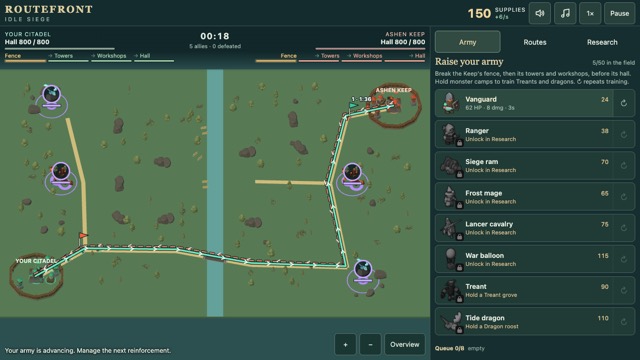
Lane Defense is a direct example. Enemies drive toward your base on fixed lanes, you place defenders on cells beside those lanes during a build phase, and every enemy that leaks through costs a life. Hold the Gate strips the idea down to a single action: tap a lane to send your next defender into it. Routefront turns the idea around, because you are also the attacker, choosing which road your army marches to break the enemy keep.
Principle 1: a leak is worse than it looks
A "leak" is an enemy that gets past your defence. Beginners often treat a leak as a small loss: one life out of many. The real cost is usually larger.
First, many games make tougher enemies cost more when they get through. In Hold the Gate, spearmen and archers knock one point off the gate's eight, a rider knocks off two and a siege ram four. Second, a leak often means your defence in that lane is already behind. If one enemy got through this wave, the next wave, which is bigger, will probably send two.
The practical habit is to treat the first leak as a warning, not a cost. When something gets through, ask why before the next wave: was that lane under-built, was the wrong kind of defender there, or did too many enemies arrive at once?
Principle 2: economy versus defence
Most tower defense games give you two ways to spend: things that stop enemies now, and things that make you stronger later. Getting the balance right is the heart of the genre.
Spending everything on immediate defence is safe but slow; you may hold early waves easily and then fall short when the late waves arrive. Spending heavily on growth is efficient but risky; one under-defended wave can end the run before the investment pays off.
Lane Defense gives you a clear version of this choice. Gold buys levels for a single unit or global weapon tech that improves every unit of a class. Upgrading one unit is a direct answer to a lane that is struggling. Weapon tech is slower to feel but helps every unit you place from then on. A healthy approach is to fix today's weak spot first, then put spare gold into tech. Lane Defense also rewards starting a wave before the build timer ends with bonus gold, which is a small economic edge you can take whenever your defence is clearly ahead.
Routefront makes economy even more central. Supplies arrive every second, your Supply depot gives six a second plus two per Supply network level, and if it is destroyed your income drops to three until you rebuild it. Monster camps add more: a Treant grove pays two supplies a second and a Dragon roost three. Protecting and expanding income early is what lets you afford a winning army later.
A useful rule of thumb
Invest when you are comfortably ahead, and defend when you are not. If the last wave died well before it reached the end, you have room to spend on growth. If it came close, spend on defence first.
Principle 3: cover every lane
It is natural to build where the action is. But a defence that is strong in one lane and bare in another will be found out, because later waves often come down more than one lane at once, or switch lanes between waves.
Hold the Gate shows this clearly. In the first two waves each lane holds a single type of attacker for the whole wave. From wave six, two lanes can be attacked at once, and from about a minute and a half in, attackers arrive faster than one send a second can answer. The players who last longest are the ones who keep a defender available for every lane rather than reacting to the lane that looks busiest.
In Lane Defense, the build phase shows the next wave's enemy types and traits. Use that preview to check each lane, not just the one that struggled last time.
Principle 4: counters beat raw power
Most defense games use some form of counter system. One defender is strong against one kind of enemy and weak against another. Matching the answer to the threat is almost always better than building more of your strongest general unit.
- In Lane Defense, mortars handle swarms, cryo emitters handle shielded enemies, lances handle armour and skyhooks handle aircraft.
- In Hold the Gate, spears beat riders, riders beat archers and archers beat spears, while the same type trades. A siege ram wins every fight but loses one of its two hit points each time, so it takes two defenders to stop.
- In Routefront, siege rams do triple damage to structures, melee units cannot hit flyers, and rangers, frost mages and towers can.
Hold the Gate adds a helpful tool: each lane with an attacker shows whether your next defender would win, lose or trade against the first attacker it would meet. Reading those markers before you tap is the difference between guessing and planning.
Principle 5: focus fire
When damage is spread across many enemies, each one takes longer to die, and enemies that are still alive keep advancing. When damage is concentrated, enemies die one at a time and stop being a threat sooner. This is focus fire, and it applies to placement as much as targeting.
In a tower game, it means building defenders where their ranges overlap, so several of them hit the same stretch of lane. A cluster of three towers covering one bend will usually do more than three towers spread along the whole path, because enemies spend time in all three ranges at once.
Bosses are where focus matters most. Lane Defense boss waves change at two thirds and one third health, so the advice there is to build up damage before the boss wave rather than during it. Lane Defense also has call-ins, such as Airstrike, Orbital, EMP and Repair, that recharge between uses. Keeping one ready for a boss or for a lane that is about to leak is a form of focused, on-demand damage.
Principle 6: time is on someone's side
Many defense games are built so that waiting hurts you. Enemies scale up, timers run down, or the opponent improves. Routefront is explicit about this: the Keep's soldiers gain health and damage over time, up to 50% more, and it repairs its fence and towers whenever your army is away from its walls. The lesson is to press your attack while you have an advantage rather than waiting for a perfect army.
Hold the Gate is the other extreme: it has no ending, and waves keep speeding up until the gate falls. There, the goal is to make each decision count for as long as possible, not to win outright.
A checklist between waves
- Did anything leak? If so, which lane, and why?
- What is coming next, and do I have the right counter in each lane?
- Is my defence clearly ahead? If yes, spend on economy or tech.
- Are my defenders placed so their ranges overlap?
- Is an emergency tool charged for the next big threat?
Work through that list every time and most of the genre's traps become visible before they cost you.