Strategy guide · 5 min read
Nightrun guide: lane choice, coin lines and close calls
How Nightrun's hazards, speed ramp, coins and close-call bonus work, and how to plan lane moves so you score more than distance and last longer on the road.

Updated 29 September 2026 · How we write guides
 NightrunThree lanes. Change lane. That is all.Play free
How a run works
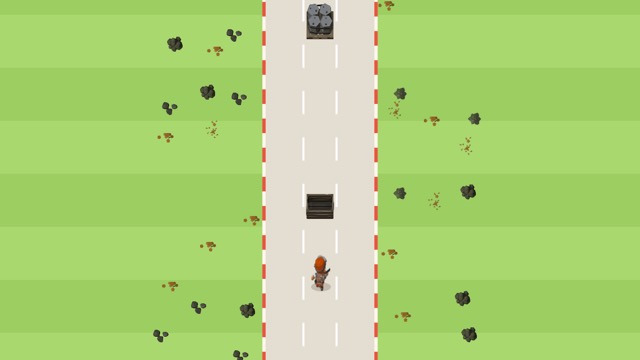
You start in the middle lane with a single crate ahead of you in that same lane. That first crate is the whole tutorial: step left or right and let it pass. From there, rows of hazards keep coming, each one a single pattern, and the road speeds up the whole way. Your score is distance plus bonuses: 1 point for every lane-width of road covered, 5 for a coin, 10 for a close call. One collision ends the run.
A lane change takes 0.13 seconds. Taps queue, so two quick taps in the same direction take you across two lanes in about a quarter of a second, and a tap into the wall is ignored.
The ramp, in numbers
Two things tighten at once: the road speeds up by 5.5 units per second every second, and the space between rows shrinks. The result is how long you get between one decision and the next:
| Time into the run | Road speed | Seconds between rows |
|---|---|---|
| 0 s | 330 | 1.70 |
| 30 s | 495 | 0.95 |
| 60 s | 660 | 0.58 |
| 90 s | 825 | 0.38 |
| 120 s | 990 | 0.31 |
Rows stop getting closer at about 83 seconds, and the road reaches its top speed of 1150 at about two and a half minutes. Every screen shows the same length of road ahead, so your warning time depends only on speed: roughly 2.4 seconds at the start, 1.2 seconds at the one-minute mark, and about 0.7 seconds at top speed.
Distance points also speed up with the road. At the start you earn about 3 points a second just by staying alive; at top speed it is over 11. Staying alive late in a run is worth more than it was early.
The hazards and how each is solved
- Crate. Blocks one lane. Either neighbour is safe. Most of the time two coins sit just behind it in its own lane.
- Barrier. Blocks two lanes and leaves its gap in the left or right lane, never the middle. A coin sits in the gap, level with the barrier, and half the time another sits just behind the far end of the barrier.
- Gate. Two crates on the edge lanes; only the middle is open, and a coin sits there.
- Imp. Crouches in one lane, faces the lane it is about to jump into, then dashes across in 0.3 seconds. It jumps when it is roughly 0.8 seconds from reaching you. An imp in an edge lane always jumps into the middle; an imp in the middle can go either way, so read its facing.
For the first 6 seconds you only see crates. Barriers join until 14 seconds, and after that the mix is roughly three crates, two barriers, two imps and one gate out of every eight rows.
Why the middle lane is home
The middle lane is one step from every answer. A barrier's gap is always one move away from the middle, but two moves from the wrong edge. A gate is solved by being in the middle. A crate in the middle lets you choose either side. The one exception is an edge imp, which always lands in the middle, so when an imp crouches on an edge facing inwards, its own lane becomes the safe one and its coin is waiting there.
Get into the habit of returning to the middle after each dodge unless the next row is already visible and tells you otherwise.
Scoring beyond distance
Crate coins. The two coins behind a crate are close to its back edge. The first one comes only a moment after the crate clears you, so start your move back as the crate draws level rather than after it has gone. The second coin sits further back and is easier to take if you are a little late.
Close calls. A close call is judged the instant you tap: if something in the lane you are leaving would reach you within 0.3 seconds, the bonus is marked. It is only paid once that hazard has passed without touching you. Because it is measured in time, the window is the same feel at every speed, though it covers more road the faster you go.
Combining them. The richest line through a crate is a late step out (10 points) followed by an early step back in (up to 10 more from its coins). That is 20 bonus points from a single row, more than six seconds of distance at the starting speed.
Common mistakes
- Dodging to an edge by reflex. From an edge, a barrier whose gap is on the other side needs two moves.
- Reacting to where an imp is rather than where it faces. The lane it crouches in is the one that will be safe.
- Chasing a barrier's far coin when the next row is already close. Past 60 seconds, rows arrive about every half second.
- Taking close calls on imps. Their position changes mid-row, so a late move is much riskier than it is with a crate.
Fairness you can rely on
Every new row is checked against the previous one: from every lane that was safe before, a safe lane must be reachable in the time available, with lane moves budgeted 40% slower than you actually make them. If a random row fails that check a dozen times, the game places a single crate in a lane you cannot be in. So whenever a row arrives, a safe lane was reachable from any lane that was safe for the row before, as long as you started moving when it came into view rather than detouring for a coin.
If you're stuck
Play a few runs where you ignore every coin and just return to the middle after each dodge. Once you can reliably reach a minute, add crate coins, then close calls on crates only. Leave imp coins until last, since they reward reading the facing correctly and punish guessing.
Ready to try it?Nightrun is free and runs in your browser.Play now