Strategy guide · 5 min read
Wordfall guide: score big and keep the well from filling
How Wordfall scores words, how fast the letters come, and how to use long words, chains and Reveals to stay alive longer and post a higher score.

Updated 29 September 2026 · How we write guides
 WordfallLetters fall. Spell them out before the well fills.Play free
What a run really asks of you
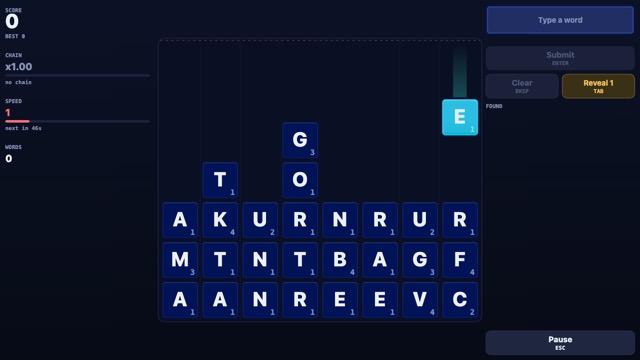
Wordfall has one way to lose: a letter lands on a column that already holds seven tiles. Everything else, including score, is about managing that. The well is 8 columns by 7 rows, so it holds 56 tiles, and a run begins with 24 of them already placed. The starting rows always contain at least one real word of four to seven letters.
Every word you submit does two jobs at once. It scores, and it removes tiles so that everything above them drops down. A good word is one that does both well: it is long, and it takes letters out of the tallest columns.
How letters arrive
Letters fall one at a time. The game picks the column with a weighting that strongly favours columns with more room, so the well tends to fill evenly rather than spiking in one spot. A nearly full column is less likely to be picked, but never safe.
The gap between letters shrinks by 12% every 55 seconds, shown as a speed step with a countdown bar:
| Speed | Starts at | Seconds between letters |
|---|---|---|
| 1 | 0:00 | 2.00 |
| 2 | 0:55 | 1.76 |
| 3 | 1:50 | 1.55 |
| 4 | 2:45 | 1.36 |
| 5 | 3:40 | 1.20 |
| 6 | 4:35 | 1.06 |
| 7 | 5:30 | 0.93 |
| 8 | 6:25 | 0.82 |
It keeps shrinking until it bottoms out at 0.55 seconds from speed 12. Letters also fall faster through the well at each step. Two adjustments soften this: the first six seconds run 30% slower, and whenever fewer than 12 tiles are settled in the well, letters arrive at less than half the normal gap so a well you have cleared does not sit empty.
The letter mix follows English frequency. E is the most common tile and J, Q, X and Z are the rarest. Two rescues protect you from bad luck. If vowels fall below a third of the letters in the well, the next letter is forced to be a vowel, and if vowels climb above 55% the next one is a consonant. If a Q lands with no U anywhere in the well, the very next letter is a U.
Scoring in detail
A word scores its letter values, multiplied by a length multiplier, multiplied by your current chain.
- Letter values: 1 for E A R I O T N S, 2 for L C U D, 3 for P M H G, 4 for B F Y W K V, 8 for X Z J Q.
- Length: 3 letters ×1, 4 ×1.4, 5 ×2, 6 ×2.8, 7 ×3.8, 8 ×5, 9 ×6.5, 10 ×8.
- Chain: starts at ×1, and each word adds 0.2 to the multiplier for the next word, up to ×3.
The sum is shown under the staging line as you build, so you can check a word's value before you commit it. To see why length matters, take CAREFUL. Its letters add up to 13, and at ×3.8 that is 49 points. Split the same seven letters into CAR and FUEL and you get 4 plus 13, about 17. Same tiles out of the well, a third of the score.
The chain window is nine seconds, and it restarts every time you land a word. Your first word is always at ×1; the second, if it comes within nine seconds, is at ×1.2; the tenth consecutive word reaches the ×3 cap. When the window runs out the multiplier drops straight back to ×1.
Opening plan
- Look at the bottom rows before the first letter lands. There is a word of four to seven letters in the starting tiles, and a strong opening word gives you both points and room.
- Aim for five letters or more from the start. At speed 1 a letter arrives only every two seconds, so this is the cheapest time to spend a few seconds searching.
- Do not spend your Reveal yet. You start with only one, and it is more valuable later when letters are coming faster.
Mid and late game
Once you are past speed 4, the well fills noticeably faster than a slow searcher can empty it. The priorities shift:
- Keep the chain running. Submitting something every nine seconds holds the multiplier. A quick three- or four-letter word is worth submitting just to keep a ×2 or higher chain alive, then follow it with a longer word at the higher multiplier.
- Clear the tallest column first. A column that reaches six tiles starts pulsing and ticking, and the next letter into it may end the run. When you type, the game already takes each letter from the tallest column that has it, and from the deepest tile in that column. If you want a specific tile from a specific column instead, tap it directly.
- Use rare letters in longer words. An X, Z, J or Q is worth 8, but it is also a tile that can sit uselessly for a long time. Getting one into a six- or seven-letter word both multiplies well and removes a blocker.
- Earn Reveals back. Every word of seven letters or more returns a Reveal, up to five held at once. A Reveal stages a common word, usually four to seven letters long, that can really be spelled from the well, and it scores at half points. It is best used when a column is at six and you cannot see anything.
Common mistakes
- Dumping many three-letter words. They score ×1 and keep you alive only briefly. They are fine for holding a chain, not as your main plan.
- Staging a long word while a column is about to overflow. The clock does not stop while you type, so check the pulsing columns before you commit to a slow search.
- Worrying about wrong guesses. A word the dictionary refuses costs nothing except time: your selection stays in place so you can fix it, and the chain is not reset by the rejection itself.
- Forgetting plural and past forms. Plurals, -ed and -ing forms and British spellings are accepted, and they are an easy way to stretch a five-letter word to six or seven.
If you're stuck
- Press Tab (or Reveal on touch) if you have a charge. It only offers ordinary words, never obscure dictionary entries.
- Look for common endings in the well: S, ED, ING, ER. Adding one to a short word often jumps it a whole length multiplier.
- After a run ends, the results screen shows a five- to eight-letter word that was still sitting in the well. It is a useful hint about the kind of word you tend to miss.
Ready to try it?Wordfall is free and runs in your browser.Play now