Strategy guide · 5 min read
Sumspill guide: build big groups, keep the well alive
How Sumspill scores, speeds up and picks targets, with the real multipliers and timings, plus a plan for turning quick three-tile clears into big payouts.

Updated 29 September 2026 · How we write guides
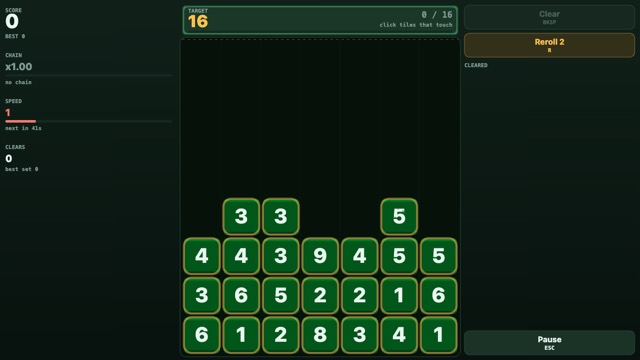 SumspillPick tiles that touch and add up to the target.Play free
How a run actually works
A run starts with three full rows already in the well, and the first falling tile arrives about 1.4 seconds after you press Play. The well is seven columns by eight rows, 56 tiles at most. The run ends at one moment only: a falling tile arrives at a column that already holds eight. A column with seven tiles starts pulsing, so you always get a warning.
There is no timer on a target and no penalty for taking your time over one. What pushes you along is the stream of new tiles, which speeds up in steps every 50 seconds, and the chain bonus, which rewards clearing again within ten seconds.
The score formula
Every clear pays:
target x size multiplier x chain multiplier, rounded.
| Tiles in the group | 3 | 4 | 5 | 6 | 7 | 8 | 9 | 10 or more |
|---|---|---|---|---|---|---|---|---|
| Size multiplier | x1 | x1.6 | x2.4 | x3.4 | x4.6 | x6 | x7.6 | x9.4 |
The chain multiplier starts at x1. Each clear adds 0.2 to it for the next clear, as long as that next clear comes within ten seconds. So after one clear you are at x1.2, after five linked clears x2.0, and after ten you reach the cap of x3. Let the ten seconds run out and it drops straight back to x1.
Put together: a target of 21 made from six tiles with a x1.2 chain pays 86. The same 21 made from three tiles with no chain pays 21. The size table matters far more than speed does.
How targets are chosen
The target is never random. After every clear the game scans every connected group of up to six tiles in the well and lists the sums they make. It then keeps only sums that:
- need at least a minimum number of tiles even in their smallest answer, so there is no two-tile shortcut
- can be made in at least three different ways
- sit close to an ideal value for the current speed level
It picks at random from the six sums nearest that ideal, and it avoids handing you the same number you just cleared. The scan stops at six tiles, but you do not. You can keep adding touching tiles past six as long as the running total stays at or under the target, which is how seven-to-ten-tile clears happen.
The ideal and the minimum group size climb with speed:
| Speed | Starts at | Ideal target | Smallest answer needs | Seconds between tiles |
|---|---|---|---|---|
| 1 | 0:00 | 14 | 3 tiles | 2.20 |
| 2 | 0:50 | 17 | 3 tiles | 1.94 |
| 3 | 1:40 | 20 | 3 tiles | 1.70 |
| 4 | 2:30 | 23 | 4 tiles | 1.50 |
| 5 | 3:20 | 26 | 4 tiles | 1.32 |
| 6 | 4:10 | 29 | 4 tiles | 1.16 |
| 7 | 5:00 | 31 | 5 tiles | 1.02 |
After speed 7 the target stays around 31, but tiles keep coming faster until they hit a floor of 0.6 seconds apart at speed 12. Falling tiles also move a little faster at each step. The first six seconds of a run are slower still, with gaps 35% longer.
The tile spacing in the table applies when the well holds 18 or more tiles. Below 18 the spacing shrinks, down to 30% of normal on an empty well, so a thin well fills back up quickly.
What the tiles will be
The digits run from 1 to 9 with no zero, weighted toward small numbers. Out of every 100 tiles, about 16 are 1s and only about 7 are 9s. Two safety rules sit on top of that. Once eight or more tiles are settled, if their average climbs above 5.6 the next tile is a 1 to 4, and if it falls below 3.0 the next tile is a 5 to 9. New tiles also favour the emptiest columns, so the well tends to fill evenly.
Opening plan
- Use the calm first minute to learn the shape of big answers. At a target of around 14, look for five or six small tiles in a snake shape along the floor rather than an 8 and a 6.
- Clear something within ten seconds of each previous clear once you have started, even if it is small, so the chain climbs while tiles are slow.
- Keep both starting Rerolls unless the target really is buried. Each six-tile clear hands one back, up to five, so in a good run they refill themselves.
Mid and late game
- Count from the low tiles outward. Start a group on a 1 or 2 and grow it through its neighbours. Each small tile adds size multiplier without eating much of the target.
- Stop just short and look. When you are a few below the target, a touching 1 and 2 are worth more than the 3 that finishes it: one more tile for the multiplier.
- Watch the column heights, not just the numbers. Clearing from a tall column drops everything above it, which lowers the danger and rearranges what touches what. Clearing a group entirely from the floor of short columns does little for your safety.
- Do not empty the well. A nearly empty well can only offer small targets made of a few tiles, and small targets pay little.
- Use a Reroll when the answers are awkward, not when the number is. A Reroll clears your current selection and swaps in another target that is also on the board. It is worth spending when every answer to the current target is tucked into a corner that would leave a tall column standing.
Common mistakes
- Taking the first three-tile answer every time. At x1 against x3.4 for six, you are giving up most of the points.
- Letting the chain drop while hunting for a perfect group. A quick clear keeps the multiplier alive; the big group can come next.
- Picking a tile in the middle of your group to undo it. Taking back a tile also takes back every tile picked after it. On a keyboard, Backspace removes only the last tile and Delete clears the whole selection.
- Tapping a tile that does not touch your group. That throws your selection away and starts a new one from that tile.
If you're stuck
If no tiles are lit, your sum has no legal next step, so undo a tile or two. The target always has at least three answers; try groups that climb between columns instead of running along a row. If a column is pulsing and you cannot find a group that reaches into it, spend a Reroll; a different target may have its answer in that column.
Ready to try it?Sumspill is free and runs in your browser.Play now