Strategy guide · 4 min read
Siding Yard guide: work out par, then park wagons to match it
Work out par in Siding Yard before your first move, keep every siding counting down, and see why best fit stops working from yard 7, with a worked example.

Updated 29 September 2026 · How we write guides
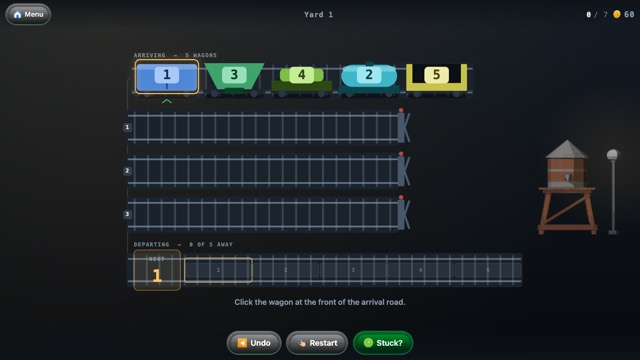 Siding YardThe wagons arrive in the wrong order. They leave in the right one.Play free
What you are really solving
The train arrives in a fixed order and must leave as 1, 2, 3 and so on. You have four moves and only four:
- Out: the front arrival wagon goes straight to departure, if it is the number due.
- Park: the front arrival wagon goes into a siding with room.
- Pull: the wagon at a siding's mouth goes to departure, if it is due.
- Shunt: the wagon at a siding's mouth moves to another siding with room.
Nothing is refused for being unwise. You can park wagon 9 on top of wagon 2, and wagon 2 will stay there until you move 9 again. Only the front arrival wagon can be picked up; the rest of the queue is there for reading, not touching.
Par is something you can work out yourself
Every move counts, including each wagon that leaves. Par is:
number of wagons + number of wagons that have a smaller wagon arriving after them
A wagon with nothing smaller behind it in the queue can roll straight through when its turn comes. A wagon with something smaller behind it has to be parked once and pulled once. So par is the number of moves when every wagon moves the minimum number of times, and every yard the game gives you can be cleared in exactly that many.
This gives you a quick check before you start. Walk the queue from the back, keep track of the smallest number you have seen, and count every wagon bigger than that smallest number. Those are the wagons that must be parked. Everything else should go straight out.
A small worked example
Say the queue is 4, 2, 5, 1, 3. Wagons 4, 2 and 5 each have a smaller wagon behind them, so par is 5 + 3 = 8. One line that hits it:
- Park 4 in siding A.
- Park 2 on top of 4 in siding A, since 2 is smaller.
- Park 5 in siding B. It cannot go on 2 without burying it.
- Send 1 out.
- Pull 2 from siding A.
- Send 3 straight out, because it is now due.
- Pull 4 from siding A.
- Pull 5 from siding B.
Notice step 6: 3 never needed parking, and parking it anyway would have cost two extra moves.
Keep every siding counting down
The rule that makes par possible: only ever park a wagon on top of a bigger number. Then each siding counts down toward its mouth, the smallest wagon still in the yard is always at a mouth, and nothing ever needs a second move. A wagon with a smaller number on top of it wears hazard stripes. Stripes do not mean the yard is lost, but every striped wagon costs you shunting moves to dig out, which puts you over par.
Why best fit fails from yard 7
The natural habit is best fit: park each wagon on the siding whose mouth is the smallest number still bigger than it, and open an empty siding only when nothing fits. It works on yards 1 to 6. From yard 7 on, the game discards any yard that best fit can clear, so every yard is built to punish it.
Yard 9 shows how. It has nine wagons and three sidings two deep, which is six places for the six wagons that must be parked. Best fit puts 7 on top of 9, because 9 is the smallest bigger mouth. Then 8 arrives, and the only wagon bigger than 8 is buried. The working line keeps 9 free for 8 and starts a fresh siding for 7. You only see that by reading several wagons ahead.
The habit to build: before you park a wagon on a mouth, scan the rest of the queue for any wagon that fits between the two numbers. If one is coming, that mouth might be its only home.
How the yards ramp
| Yards | Wagons | Siding depth | Best fit works? |
|---|---|---|---|
| 1 to 2 | 5 to 6 | 4 | Yes |
| 3 to 6 | 7 to 9 | 3 | Yes |
| 7 to 30 | 9 to 14 | 2, 3 or 4 | No |
| 31 onward | 13 to 14 | 2, 3 or 4, rotating | No |
The two-deep yards are the tightest. With three sidings, that is six places in total. Yards 9, 12, 15, 18, 21, 25, 27 and 29 in the ramp are two deep.
Coins and scoring
A cleared yard pays 12 coins, plus 8 if you used no paid help, plus 6 if you finished at or under par. Undo and restart are free. Undo also takes one move off your count, so experimenting never costs you the par bonus. Buying help does lose you the no-help bonus for that yard, and restarting does not give it back.
Common mistakes
- Parking a wagon that could have gone out. If the front wagon is the number due, send it.
- Parking by habit on the closest mouth. From yard 7, the closest fit is often the trap.
- Filling a siding to the buffer stop early. On two-deep yards a full siding leaves you nowhere to shunt a blocker.
- Tapping out wagons one at a time. With nothing picked up, one tap on the departure road sends every ready wagon in a row. Each still counts as one move, so this changes speed, not score.
If you're stuck
When nothing can move, the help panel opens and tells you whether the yard can still be cleared. If it can, undo back to the last wagon you parked on something smaller and try a different siding. If you want help, a shunter makes the next three correct moves for 25 coins; they count toward your total. A fourth siding costs 40 coins and can be bought once per yard. You start with 60 coins.
Ready to try it?Siding Yard is free and runs in your browser.Play now