Strategy guide · 5 min read
Meltpour guide: plan every fusion before you pour
How pours and fusions really work in Meltpour, how the levels ramp, what par and ingots reward, and a step-by-step way to fill any docket without scrap.

Updated 29 September 2026 · How we write guides
 MeltpourPour two metals together and they fuse for good.Play free
What a pour actually does
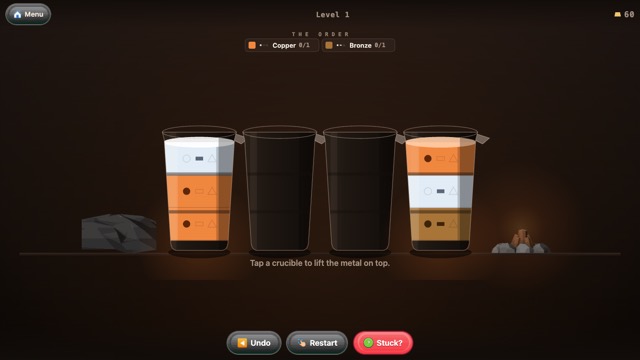
Every move is the same action: lift the top run of one crucible (all the touching bands of the same alloy at the top) and pour it into another. How much moves depends on room. If the run is three bands and the destination has space for one, only one band goes across.
What happens next depends on what is on top of the destination:
- Empty, or the same alloy: the metal lands unchanged.
- A different alloy: the poured bands and the destination's entire top run all become one new alloy, the union of every metal involved.
That second point is the one most players miss. Fusion does not only change the bands you poured. If a crucible has three copper bands on top and you pour a single tin band onto it, all four become Bronze. One band can convert a long run, which is often the cheapest way to make an alloy. It also means one careless band can spoil a run you wanted to keep pure.
The only pour the game refuses is one into a full crucible.
The seven alloys
| Alloy | Metals inside | Stamp |
|---|---|---|
| Copper | copper | disc |
| Tin | tin | bar |
| Zinc | zinc | wedge |
| Bronze | copper, tin | disc and bar |
| Brass | copper, zinc | disc and wedge |
| Pewter | tin, zinc | bar and wedge |
| Gunmetal | copper, tin, zinc | all three |
Fusing can only add metals. A band can end up in a mould only if that mould's alloy contains every metal the band already has. A Brass band can become Gunmetal, but it can never become Bronze or Copper.
How the levels ramp
Each level fills a docket of moulds, and every mould is one full crucible of one alloy.
| Levels | What changes |
|---|---|
| 1 to 3 | Copper and tin only, crucibles hold 3 bands, 2 or 3 moulds, two empty crucibles |
| 4 and 5 | Zinc arrives, crucibles hold 4 bands |
| 6 | First Gunmetal on the docket |
| 9 | First bench with only one empty crucible |
| 12 | First bench with 5-band crucibles |
| 13 to 30 | Up to 10 moulds; one-spare benches at 13, 17, 20, 23, 26 and 29 |
| 31 onward | Rotates through four hard shapes of 9 or 10 moulds |
Every bench is built backwards from the finished docket, so it can always be solved from the start.
Ingots and par
A finished level pays 12 ingots, plus 8 if you used no paid assist, plus 6 if your pour count is at or under par. That is 26 at most. Par is the length of the solution the level was built from, plus two pours of slack.
Undo is free, does not count as an assist, and takes one off your pour count, so trial and error never costs you the par bonus. Restart sets the count back to zero. It does not clear the assist flag, though: once you buy help on a level, the no-assist bonus is gone for that level, even after a restart.
A method for any docket
- Count before you touch anything. For each metal, count the bands that contain it and the moulds that need it. Every Bronze, Brass or Gunmetal mould needs at least one band carrying each of its metals, and every plain Copper, Tin or Zinc mould needs a full crucible of untouched metal.
- Protect the plain moulds first. A docket asking for plain Copper needs a crucible's worth of copper that never touches anything else. Decide early which copper bands are for that mould and keep them away from tin and zinc.
- Consolidate before you fuse. Merging same-alloy runs and using empty crucibles changes nothing permanently. Get runs together so that when you do fuse, you convert a whole run in one pour.
- Fuse on purpose. Look at the badge before the second tap. An amber badge names what you will make. If that alloy is not on the docket and is not a step toward a Gunmetal mould, stop.
- Build Gunmetal last. A full crucible of Bronze, Brass or Pewter is still raw material when the docket also wants Gunmetal, so it does not lock in. Finish the two-metal moulds you need first, then use leftovers for Gunmetal.
A crucible that is full, pure, on the docket and not needed for any larger alloy gets a cast collar. Treat it as finished and leave it alone.
Benches with one spare
From level 9, some benches have a single empty crucible. It is the only place metal can wait without meeting another alloy. Use it for a short run you will move again within a pour or two, never as long-term storage. If you park a run there and nothing can take it back, you have no free space left for anything else.
Common mistakes
- Trusting the absence of red. The crimson SCRAP warning is exact: it means the metal can no longer fill the docket. But a bench can also get stuck on space alone, with no pour left, and no warning covers that.
- Dropping a stray band on a long run. The whole top run fuses, not just the band you poured.
- Over-fusing. A bench of all-pure Gunmetal is not a win if the docket wanted Copper and Bronze.
- Filling a plain mould with the wrong copper. If the copper you need to make Bronze is sitting under your plain Copper mould, you have to dig it out again.
If you're stuck
The game handles two different dead ends. When the metal can no longer make the docket, the assist panel opens by itself, and its free rewind steps back one pour at a time to the exact pour that caused the damage. When pours are simply blocked, undo a few steps and look for a way to get an empty crucible back.
The paid help is for being stuck, not for a spoiled bench:
- Hint, 25 ingots: lights the next pour on a known line to the finish.
- Quench, 35 ingots: pick a crucible and the bench rolls back to just before it was last fused. Every pour made after that point is undone too.
- Extra crucible, 40 ingots: one more empty crucible for this level, once per level. It stays if you restart.
If a paid assist has nothing to deliver, you get the ingots back. You start with 60.
Ready to try it?Meltpour is free and runs in your browser.Play now