Strategy guide · 5 min read
Facet Circuit guide: braking points, grip and medal times
How the car in Facet Circuit grips, brakes and loses speed, the medal times for all four circuits, what coins pay for, and a method for cutting your lap time.

Updated 29 September 2026 · How we write guides
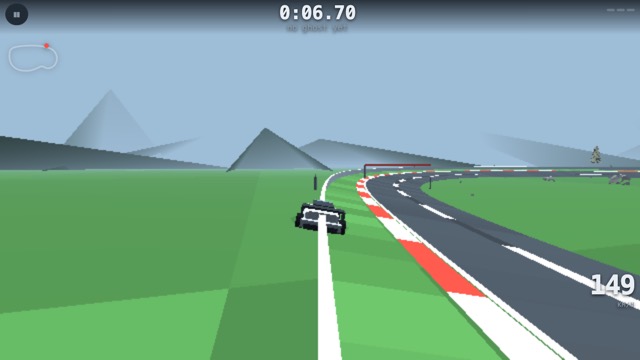 Facet CircuitOne flying lap, and the corner you know you got wrong.Play free
What a lap is
Every attempt is one timed lap from a standstill. The clock runs from the moment you start until the car has covered one full lap of track distance. Throttle is always on unless you are braking, so your only inputs are left, right and brake. On a keyboard those are the arrow keys or A and D to steer and Down, S or Space to brake. R restarts the lap instantly, and Esc or P pauses.
Once you have a best time on a circuit, a translucent ghost replays that lap alongside you, and the head-up display shows your live gap to it. Each lap is also split into three equal sectors, and each sector flashes your gain or loss against the splits of your best lap.
Medal times
Gold is a measured reference time for each circuit. Silver allows 10% more and bronze 24% more.
| Circuit | Road width | Gold | Silver | Bronze |
|---|---|---|---|---|
| Sable Ring | 12.4 m | 0:19.36 | 0:21.30 | 0:24.01 |
| Cinder Loop | 11.6 m | 0:26.54 | 0:29.19 | 0:32.91 |
| Wick Ridge | 11.0 m | 0:19.73 | 0:21.70 | 0:24.46 |
| Glass Spine | 10.0 m | 0:30.05 | 0:33.06 | 0:37.27 |
A bronze or better unlocks the next circuit in that order.
How the car actually behaves
Grip is a hard ceiling
The car can only turn as fast as its grip allows at the current speed. Steer harder than that and nothing more happens: the car simply runs wide. The maximum speed through a corner therefore depends on how tight the corner is. On tarmac, a rough guide from the handling numbers:
| Corner radius | Fastest speed through it |
|---|---|
| 20 m | about 73 km/h |
| 50 m | about 115 km/h |
| 100 m | about 163 km/h |
If you arrive faster than the corner allows, the only fix is to brake. More steering will not help.
Steering lock also shrinks as you go faster. At top speed you have well under half the lock you have when slow, so you cannot rescue a high-speed mistake with a sharp flick either.
Braking
Pressing brake cuts the throttle and applies full braking together, which sheds roughly 105 km/h every second. That is strong, so one short, firm stab before turn-in usually does the job. Holding the brake into the corner itself just loses time you did not need to lose.
Surfaces
- Kerb: a 1.3 m strip beyond the road edge. Grip drops to about three quarters of tarmac, so your cornering speed falls by around 13%, and the kerb adds drag.
- Grass: beyond the kerb. Grip is about a third of tarmac, cornering speed falls by around 40%, and drag is much heavier and grows with speed.
- Barrier: about 5 m beyond the road edge. Hitting it while pointed into it keeps only 52% of your speed and costs you the clean-lap bonus. Sliding along it without turning into it still bleeds speed every moment you stay there.
The inside of a corner is shorter
Lap distance is measured along the centre of the road, and running on the outside of a bend covers more ground for the same progress. Running on the inside covers less. That is the whole reason for a racing line: start a corner from the outside, touch the inside at the apex, and let the car drift back out on the exit. The tighter your line, the lower your cornering speed, so the balance is yours to find.
Letting go helps
With no steering input, and only while you are off the grass, the car slowly straightens toward the direction of the road. It is gentle, weaker at high speed, and it will not take a corner for you. It does mean that releasing the steering on a corner exit is safer than holding on to a correction.
Coins
| Reward | Coins |
|---|---|
| Finishing any lap | 10 |
| Lap inside bronze / silver / gold | 20 / 45 / 90 |
| New personal best (not your first lap) | 35 |
| No barrier contact | 15 |
| First medal of any kind on that circuit | 60 |
Medal coins are paid on every lap that makes the time, not just the first. So a clean gold lap that is also a personal best pays 150. Coins only buy paint finishes, from 120 to 650. Nothing you can buy makes the car faster.
A method for cutting time
- Drive a safe lap first. Brake early everywhere. A slow first lap sets a ghost and sector splits to compare against.
- Pick one corner. Move its braking point a little later on each attempt until you run wide, then back off slightly.
- Read the sectors, not the total. A red sector tells you which third of the lap to work on next time.
- Protect the exit before a long straight. On Cinder Loop the hairpin comes at the end of the fastest straight, so a clean exit from it matters more than a late braking point into it.
- Restart freely. R puts you back on the grid at once, so there is no point finishing a lap that has already gone wrong.
Circuit notes
- Sable Ring has the widest road, two long straights and a chicane. Be off the brakes before the chicane rather than braking into it.
- Cinder Loop is about one hairpin. Brake hard and early for it; the exit decides your speed down the next straight.
- Wick Ridge climbs to a blind crest before a double left. Slopes affect acceleration here, so the climb is slow and the descent is fast. Commit to a braking point before the crest, because you cannot see the corner from it.
- Glass Spine is the narrowest at 10 m and keeps turning. Smooth, early braking beats aggression, because every barrier touch costs you nearly half your speed.
If you're stuck on a medal
Find your worst sector against your best splits, and try braking earlier there, not later. Most lost time comes from running onto the grass or into a barrier, not from braking a little too soon.
Ready to try it?Facet Circuit is free and runs in your browser.Play now