Strategy guide · 5 min read
Emberdeck guide: every card, how the opponents think, and decks that win
All 18 Emberdeck cards with costs and stats, how the computer opponents choose plays and attacks, and deckbuilding plans for beating Bram, Vexa and Orin.

Updated 29 September 2026 · How we write guides
 EmberdeckTwenty cards, three opponents, no packs to buy.Play free
How a match flows
Both heroes start on 25 health. You take the first turn with four cards in hand; the opponent starts its first turn with five. Each turn your maximum mana rises by one and refills, so you have 1 mana on turn one and reach the cap of 8 on turn eight. You draw one card at the start of each turn.
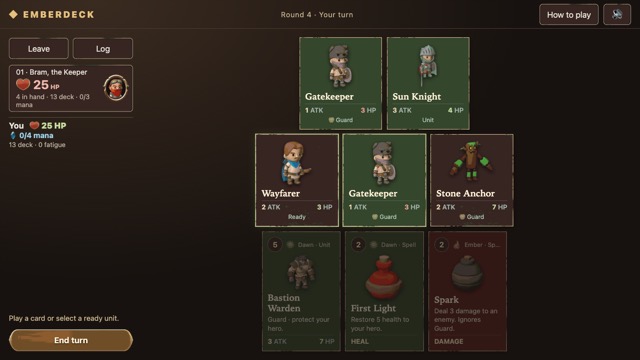
Units cannot attack on the turn they are played. When one unit attacks another, both deal their attack as damage at the same time. Damage on a unit is permanent: nothing in the game heals units, only First Light heals your hero, and never above 25. Attacking the enemy hero costs your unit nothing.
Limits to keep in mind: five units on your board, eight cards in hand (extra draws are discarded), and fatigue once your deck is empty, dealing 1, then 2, then 3 and so on per draw.
The full card list
| Card | Faction | Cost | Attack / Health | Notes |
|---|---|---|---|---|
| Dawn Squire | Dawn | 1 | 1 / 2 | |
| Gatekeeper | Dawn | 2 | 1 / 4 | Guard |
| Sun Knight | Dawn | 3 | 3 / 4 | |
| Bastion Warden | Dawn | 5 | 3 / 7 | Guard |
| First Light | Dawn | 2 | spell | heal your hero 5 |
| Cinder Scout | Ember | 1 | 2 / 1 | |
| Ash Wolf | Ember | 2 | 3 / 2 | |
| Coal Raider | Ember | 3 | 4 / 2 | |
| Furnace Giant | Ember | 6 | 6 / 7 | |
| Spark | Ember | 2 | spell | 3 damage to any enemy, ignores Guard |
| Tide Wisp | Tide | 1 | 1 / 2 | |
| Mist Seer | Tide | 2 | 2 / 3 | |
| Frost Sentinel | Tide | 4 | 4 / 5 | Guard |
| Glacier Drake | Tide | 5 | 5 / 6 | |
| Winter Seal | Tide | 1 | spell | freeze an enemy unit |
| Deep Insight | Tide | 2 | spell | draw 2 |
| Wayfarer | Neutral | 2 | 2 / 3 | |
| Stone Anchor | Neutral | 4 | 2 / 7 | Guard |
Every card can go in any deck, up to two copies each.
How the opponent thinks
The computer follows fixed habits, and knowing them is the biggest edge you have.
Playing cards. It plays the most expensive card it can afford, then repeats while it has mana. It skips First Light while above 20 health and skips Deep Insight while holding more than five cards. Winter Seal always goes on your highest-attack unit that is not already frozen. Spark goes to your hero if that kills you; otherwise it hits one of your units with 3 or less health if you have one, and your hero if you do not.
Attacking. Every ready unit attacks every turn. For each, it first checks whether it can finish your hero. If not, it attacks a unit of yours it can kill outright, preferring high attack and Guard. If none can be killed, it hits your hero, or, when a Guard is in the way, the first Guard on your board.
What it ignores. It never considers the damage coming back. If its only legal target is a sturdy Guard, its units will attack it anyway and take the Guard's attack in return.
What this means for your deck
- Tough Guards punish the opponent. Stone Anchor (2 / 7) and Bastion Warden (3 / 7) cannot be killed in one hit by most units, so the opponent throws small units into them and loses them to the counter-damage. An Ash Wolf or Cinder Scout dies attacking either one.
- Low-health units draw Spark. Anything with 3 or less health is a Spark target. If you want the opponent's Sparks to hit units instead of your face, that is fine; if you are protecting a key 3-health unit, expect it to go.
- Your biggest attacker will be frozen. When Orin has Winter Seal, your highest-attack unit is the one he seals. A second strong threat on the board makes the seal cost him more.
The three opponents
Each opponent plays two copies of every card in its starter list.
Bram, the Keeper (Dawn)
Squire, Gatekeeper, Sun Knight, Bastion Warden, First Light, Cinder Scout, Mist Seer, Spark, Wayfarer and Stone Anchor. Four of his ten card types are Guards or healing, and his Warden and Anchor each have 7 health. Your Sparks go over Guards, so hold them for his hero once the board is locked, and build units with enough attack to break a Gatekeeper in one hit.
Vexa, Ash Captain (Ember)
Scout, Ash Wolf, Coal Raider, Furnace Giant, Spark, Squire, Gatekeeper, Sun Knight, Wayfarer and Deep Insight. Her early units hit hard but have 1 or 2 health. A Gatekeeper on turn two, followed by a Stone Anchor, makes her attackers trade themselves away. Keep a Winter Seal for the Furnace Giant; its 6 attack leaves a Stone Anchor or Bastion Warden on 1 health rather than killing it.
Orin, Winter Oracle (Tide)
Sun Knight, Mist Seer, Frost Sentinel, Glacier Drake, Winter Seal, Deep Insight, Squire, Gatekeeper, Spark and Wayfarer. His strongest units cost 4 and 5, so pressure early with cheap attackers before the Sentinel and Drake land.
A general-purpose deck plan
- Take eight to ten cheap units (cost 1 to 2) so you can act on turns one and two.
- Add two Stone Anchors and at least one Bastion Warden or Frost Sentinel as walls.
- Add two Sparks for reach over Guards and for finishing.
- Finish with a few 4- and 5-cost units to use your mana in the late turns.
Common mistakes
- Attacking a unit when the enemy hero is open and the trade is even. Face damage is free.
- Playing Deep Insight with seven cards in hand: one of the two draws is discarded.
- Filling the board with five small units, leaving no room for a bigger one when you draw it.
- Forgetting that a match where both heroes fall together is a draw, not a win.
If you're stuck
Load a starter, then swap in two Stone Anchors and see how the opponent's attacks change. Watching its units run into a 7-health Guard is the quickest way to learn the habits above.
Ready to try it?Emberdeck is free and runs in your browser.Play now